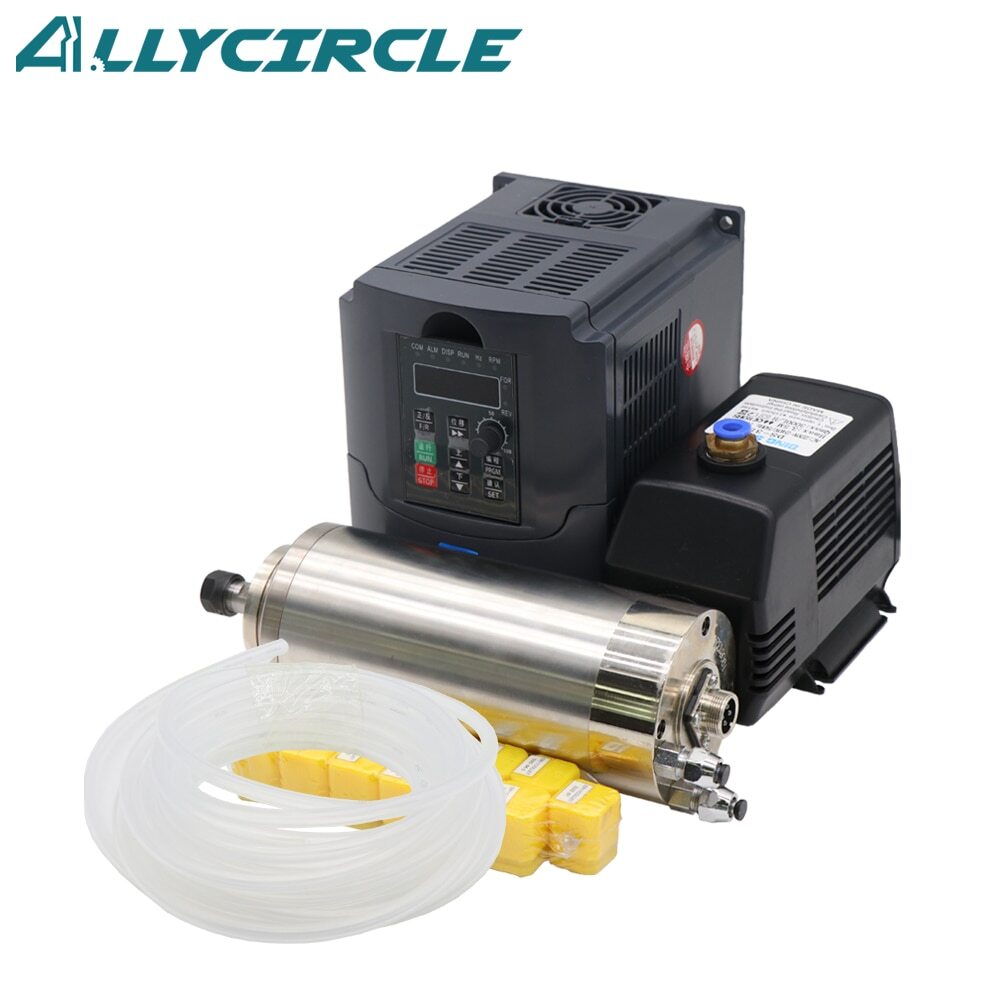
800W vs 1.5kW vs 2.2kW CNC Spindle: Pick the Right Wattage
Slug: `/guides/800w-vs-1500w-vs-2200w-cnc-spindle/`
Table of Contents
- What Wattage Actually Controls
- 500–800W Spindles: Lightweight Option
- 1.5kW Spindles: The Hobbyist Standard
- 2.2kW Spindles: Production and Aluminum
- Machine Size and Spindle Wattage Table
- Power Delivery and Electrical Reality
- Collet Size and Bit Availability
- Speed/Torque Trade-off Chart
- Weight and Z-Axis Motor Sizing
- When to Buy What
- What We'd Buy
- Shop This Guide
- Related Articles
Slug: /guides/800w-vs-1500w-vs-2200w-cnc-spindle/
Read Time: 8 min
Spindle wattage directly determines how much torque you have available at the cutter. More wattage means deeper cuts, faster feeds, and the ability to push harder materials. But bigger also means heavier, which affects your Z-axis acceleration and costs more. The question isn't "what's the most powerful," it's "what's sufficient for what I actually cut?"
What Wattage Actually Controls
Power (watts) is torque × speed. A spindle with more wattage can deliver more torque at lower RPM, or more RPM at the same torque.
Practically: a 2.2kW spindle can push a 12mm diameter 3-flute end mill through hardwood at 200mm/min depth of cut. An 800W spindle can manage maybe 3mm depth on the same bit. That's the real difference.
500–800W Spindles: Lightweight Option
Typical specs:
- Wattage: 500–800W
- Weight: ~1.2kg
- Common collet: ER11 or ER16
- Typical max rpm: 24,000
- Cost: ~$100–120
Use cases:
- 3D printers with spindle attachment (SLA resin finishing)
- Sub-600mm machines (very light-duty)
- Soft materials only (wood, plastic, foam)
Real limitations: Hardwood gets slow. Forget aluminum. If you hit a knot in wood, the spindle stalls or chatters. These are fine for hobby engraving or light plastic work, not machining.
Z-axis impact: Minimal weight. A lightweight stepper can handle it.
1.5kW Spindles: The Hobbyist Standard
Typical specs:
- Wattage: 1.5kW
- Weight: ~2.1kg
- Common collet: ER16 or ER20
- Typical max rpm: 24,000
- Cost: ~$150–180
Use cases:
- MPCNC builds (wood, plastic, light aluminum)
- Hobby routers under 800mm
- Production wood work (multiple parts, consistent feeds)
This is the workhorse. You can push real feeds on hardwood. Aluminum is cuttable but requires conservative speeds (50–100mm/min on 3mm depth). You won't stall on knots or catch grain. Most hobby builders settle here because it's adequate for 95% of hobby work.
Z-axis impact: 2kg is noticeable. Your Z-axis needs a real stepper (NEMA 23 or equivalent servo), and rapids will be slower than with the 800W spindle. Budget for this.
VFD voltage: Can run on 110V household power (draws 14A under full load). Check your breaker capacity.
2.2kW Spindles: Production and Aluminum
Typical specs:
- Wattage: 2.2kW
- Weight: ~3.5kg
- Common collet: ER20 (sometimes ER25 on special models)
- Typical max rpm: 24,000
- Cost: ~$200–250
Use cases:
- Aluminum production (5+ mm depth at moderate feeds)
- Large format machines (over 800mm work area)
- Unattended production runs (torque reserve for sustained cuts)
- Larger surfacing bits (2"+ diameter for panel work)
The 2.2kW opens up capabilities. You can run 1/2" shank bits (ER20 collet) which have dramatically better rigidity than 1/4" shanks. Chatter reduces. Aluminum cuts that would stall a 1.5kW work fine. Wood surface finishing is clean (no chatter).
Z-axis penalty: 3.5kg is real weight. Your Z-axis motor needs to be oversized. A NEMA 23 Z-axis will have slower rapids with a 2.2kW spindle than with a 1.5kW. Some builders use NEMA 34 on the Z just to maintain snappy acceleration.
VFD voltage: Really wants 220V household power (9A at 240V). Running on 110V requires a 22A breaker and heavier wiring—not ideal. Check your shop's electrical before committing.
Machine Size and Spindle Wattage Table
| Machine Size | Work Area | Primary Material | Recommended Wattage |
|---|---|---|---|
| 3018 (stock) | 300×180mm | Plastic, soft wood | 800W |
| MPCNC 500mm | 500×500mm | Wood, soft plastic | 1.5kW |
| DIY router 600mm | 600×600mm | Hardwood, aluminum | 1.5kW |
| Production router 800mm | 800×800mm | Mixed (wood + aluminum) | 1.5–2.2kW |
| Large format 1000mm+ | 1000×1000mm+ | Aluminum, steel | 2.2kW or servo |
Power Delivery and Electrical Reality
110V household power (US standard):
- Safe continuous draw: ~12–15A per outlet
- 800W spindle: ~7A (fine)
- 1.5kW spindle: ~14A (borderline, check breaker capacity)
- 2.2kW spindle: ~20A (requires dedicated 20A+ circuit, marginal)
220V household power (common in garages):
- Safe continuous draw: ~20A
- 1.5kW: ~9A (plenty of headroom)
- 2.2kW: ~10A (comfortable)
If you're on 110V and considering a 2.2kW spindle, have an electrician run a 220V circuit first. Don't try to force a 2.2kW through household 110V wiring.
Collet Size and Bit Availability
Spindle wattage determines the standard collet:
- 800W: ER11 (up to 7mm shank) or ER16 (up to 10mm)
- 1.5kW: ER16 (10mm) or ER20 (13mm / 1/2" shank)
- 2.2kW: ER20 (13mm / 1/2" shank)
Why this matters: ER20 allows 1/2" shank bits. These are rigid, reduce chatter, and are the standard for aluminum and production work. 1/4" shank bits (ER16) are adequate but more prone to deflection under aggressive feeds.
If you plan to cut aluminum at all, plan for ER20. That usually means 1.5kW minimum.
Speed/Torque Trade-off Chart
Weight and Z-Axis Motor Sizing
The spindle weight directly affects your Z-axis stepper choice:
| Spindle Wattage | Typical Weight | Z-Axis Motor | Z Rapid Speed |
|---|---|---|---|
| 800W | 1.2kg | NEMA 17 or small NEMA 23 | 100–150 mm/sec |
| 1.5kW | 2.1kg | NEMA 23 | 80–120 mm/sec |
| 2.2kW | 3.5kg | NEMA 23 or NEMA 34 | 50–100 mm/sec |
If you upgrade a 1.5kW build to 2.2kW by just swapping spindles, your Z-axis will be slower and may stall under rapid acceleration. Budget for a Z-axis upgrade (another $30–50 for a better stepper or servo).
When to Buy What
800W: Only if budget is extremely tight (~$80 cost) and you know you're cutting foam, soft plastic, or doing very light engraving. Otherwise, save the $70 and get 1.5kW.
1.5kW: Default choice for 95% of hobby builds. Adequate for wood, plastic, and light aluminum. Standard collet options. Good Z-axis balance. Widely supported by the community. Buy this unless you have a specific reason not to.
2.2kW: If you're building a large machine (800mm+), cutting aluminum regularly, or running a small production service. Accept that your Z-axis will be slower and your VFD will need 220V power. The torque reserve is genuinely useful for hard materials.
What We'd Buy
First build, budget conscious: 1.5kW water-cooled spindle kit, ER20 collet, ~$200 total with VFD. Standard choice, proven across thousands of MPCNC and hobby router builds.
Large machine or aluminum focus: 2.2kW air or water-cooled, ER20 collet, ~$240 total. Heavier, requires 220V, slower Z rapids, but handles real material at production speeds.
Second spindle for the same machine: Buy the next size up to experiment with different materials. Many builders have a 1.5kW and a 2.2kW mounted on quick-change spindle plates.
Shop This Guide
| Item | Where | Link |
|---|---|---|
| 800W Spindle Kit | Vevor | 800W spindle kit on Vevor → |
| 1.5kW Spindle Kit | Vevor | 1.5kW spindle kit on Vevor → |
| 2.2kW Spindle Kit | Vevor | 2.2kW spindle kit on Vevor → |
| 1.5kW/2.2kW Spindle Sets | AliExpress | 800W/1.5kW/2.2kW spindle sets on AliExpress → |
| Huanyang VFD 1.5kW | Amazon | Huanyang VFD 1.5kW 110V on Amazon → |