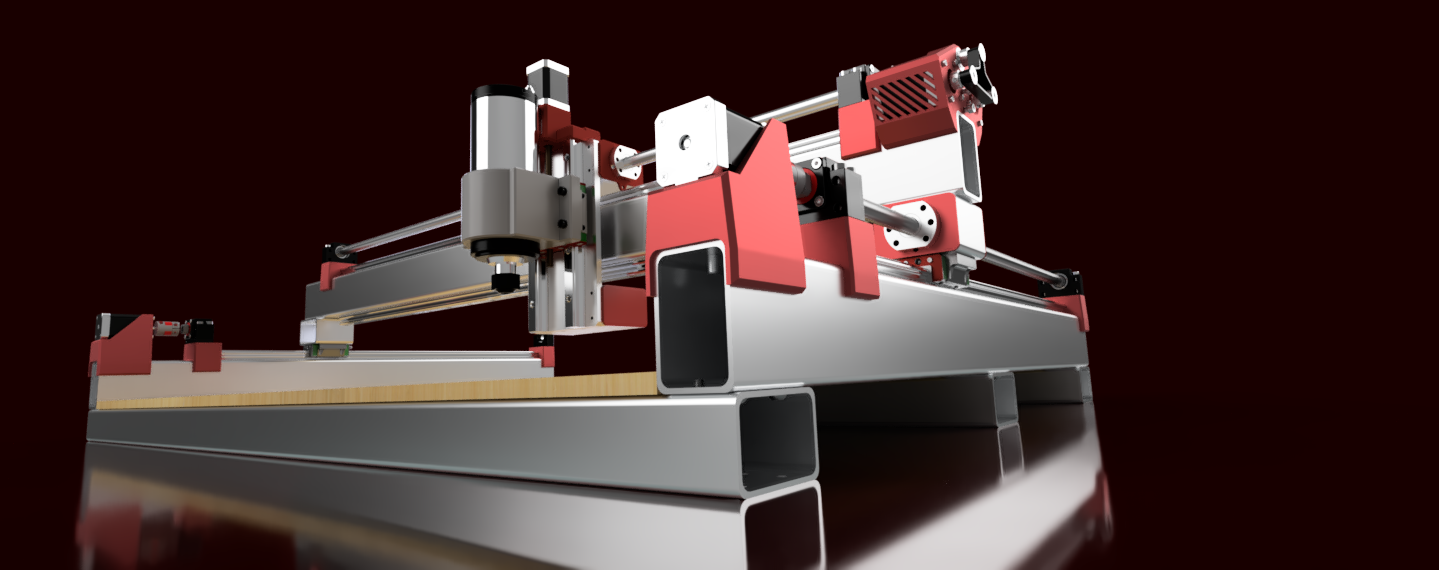
PrintNC Mini: The Desktop Steel Frame CNC That Doesn't Compromise on Rigidity
The PrintNC community has an almost embarrassing truth: smaller CNC machines are more rigid than larger ones. When you shrink the bed span from a meter to 30 centimeters, the physics shifts dramatically. Deflection drops, surface finishes improve, and the cost per unit rigidity becomes genuinely goo
Table of Contents
The PrintNC community has an almost embarrassing truth: smaller CNC machines are more rigid than larger ones. When you shrink the bed span from a meter to 30 centimeters, the physics shifts dramatically. Deflection drops, surface finishes improve, and the cost per unit rigidity becomes genuinely good. The PrintNC Mini is what happens when you apply that principle deliberately—it's the PrintNC concept, proven in steel tube, but scaled down for people whose work doesn't require a full-meter table.
If your aluminum milling work is brackets, fixtures, small signs, and jewelry—not panels or cabinet sides—the Mini is arguably a better machine than the full PrintNC. You're not paying for capacity you don't use, and you're getting the same design philosophy that makes PrintNC's Discord so useful.
What PrintNC Mini Actually Is
PrintNC Mini isn't a separate project; it's the PrintNC design scaled down to a ~300×300mm work envelope. The fundamental architecture remains: steel tube frame (typically 25×25mm or 30×30mm instead of 40×40mm), MGN12 linear rail guides, NEMA23 steppers, ballscrews. It's the same rigidity-first thinking, just with smaller numbers.
The design exists because the community built it. You won't find "official" PrintNC Mini documentation—you'll find it in Discord conversations and build logs. That's part of the appeal if you're comfortable asking questions; it's friction if you need a PDF manual. The PrintNC forums and Discord are where the knowledge lives, and the Mini builders are actively posting there.
The Cost Advantage
A full PrintNC 700×700mm build typically runs $800–1,500 depending on spindle choice and how much you source from AliExpress. A PrintNC Mini build lands at $600–900. You're saving $200–600 by not buying half a meter of rail stock, shorter ballscrews, and a smaller frame.
More importantly: cost per usable rigidity improves. That same $800 buys you a machine that's stiffer, faster in the X-Y plane (less inertia to move), and faster to fabricate. If your work is small, this is the better value proposition.
Spindle & Motor Reality
For a Mini, an 800W spindle is adequate and a 1.5kW provides headroom. Both fit comfortably in the footprint. NEMA23 motors are standard and appropriate throughout; you don't need oversize steppers at this scale.
Power delivery is straightforward: a 24V 10A power supply handles the motors; the spindle runs on 110V or 220V depending on your region. No complexity.
What You Can Cut
The Mini is purpose-built for aluminum. That's not a limitation—it's the whole point. Aluminum brackets, PCB cutouts (with care), precision wood joinery, small sign work, jewelry milling, and custom fixtures are the sweet spot.
What it's not for: anything that requires a large footprint. Panel routing, cabinet doors, full-sheet work—these don't fit. Build a LowRider if that's your use case. The Mini says no to one thing so it can say yes emphatically to everything small and precise.
Build & Documentation Reality
The PrintNC Mini is documented by community builds, not a structured guide. This means:
- Pro: people who've built one answer questions in Discord in real time
- Con: you need to know which questions to ask and be comfortable learning from examples rather than step-by-step instructions
The V1 Engineering forums and PrintNC Discord are both excellent communities, but PrintNC's is Discord-first. That's the trade. If you're already comfortable in Discord and have built or modified machines before, this is seamless. If you need a wiki and a manual, this is friction.
Mini vs. Full PrintNC: When to Choose the Mini
| Aspect | PrintNC Mini | Full PrintNC 700×700 |
|---|---|---|
| Work Area | ~300×300mm | 700×700mm |
| Steel Frame | 25–30mm tube | 40×40mm tube |
| Rail Size | MGN12 throughout | MGN12/15 mix |
| Cost | $600–900 | $800–1,500 |
| Rigidity (absolute) | Very good | Better (larger absolute stiffness) |
| Rigidity (per $) | Better | Good |
| Spindle Power | 800W–1.5kW | 1.5kW–2.2kW |
| Best For | Small precision aluminum | Aluminum + larger work |
| Assembly Time | 60–80 hours | 100–150 hours |
| Upgrade Ceiling | Solid (smaller build, less to upgrade) | Higher (more axes, larger envelope) |
The Mini wins if your work is small and precise. The full PrintNC wins if you need reach and capacity.
The Community & Upgrade Path
PrintNC Mini builders hang out in the same Discord as the full machine folks. You're not isolated; you're part of an active community that values rigidity and doesn't hedge on aluminum cutting. When someone posts "is this deflection normal?" the responses are informed by hundreds of builds.
Upgrades for the Mini typically focus on spindle quality (moving from 800W to a ceramic-bearing VFD 1.5kW) or ballscrew preload refinement (tightening tolerances over time). You're not going to "upgrade into" a larger machine—the Mini is its own thing. But that's fine. Once it's tuned, it's a solid aluminum mill that fits in a hobby shop.
Realistic Limitations
Don't build this if:
- Your work requires anything larger than 300mm in any dimension
- You need a 4×8 sheet routing capability (build a LowRider)
- You plan to do heavy facing passes in mild steel (possible, but slow)
- You want structured, step-by-step documentation from the start
Do build this if:
- You mill aluminum regularly (brackets, fixtures, precision parts)
- You have limited shop space
- You value rigidity over work area
- You're comfortable learning from Discord and community builds
- You want the best cost-per-rigidity ratio in the $600–900 range
Verdict
The PrintNC Mini is the best rigid desktop aluminum mill for under $1,000 if your work is actually small. It's not a compromise machine—it's a deliberately scaled design that improves on certain metrics (deflection, finish, footprint) by removing one dimension (work area). The community is real and responsive. Documentation is Discord-first, not PDF-first, which is either seamless or friction depending on your style.
Build this if you've outgrown an MPCNC and need aluminum rigidity without a full-size table. Skip it if you need large work area or structured learning; the MPCNC or LowRider is better positioned for those needs.
Shop This Guide
| Component | Source | Notes |
|---|---|---|
| 800W Spindle Kit | Vevor → | Water-cooled, includes mount, fast shipping |
| NEMA23 Steppers (4-pack) | Amazon: StepperOnline NEMA23 → | 2–3Nm, same motors used in full PrintNC |
| MGN12 Rail Sets | AliExpress: MGN12 300–400mm → | C0 preload, 4× rail + 8× blocks typical |
| Ballscrew Set | AliExpress: RM1605 ballscrews → | 300–350mm lengths, ~$40 for a matched pair |
| 24V 10A PSU | Amazon → | Industrial-grade, rated for continuous duty |
| Steel Tube & Hardware | Local steel supplier + McMaster-Carr | Sourcing locally saves shipping; 25–30mm 0.065" wall typical |