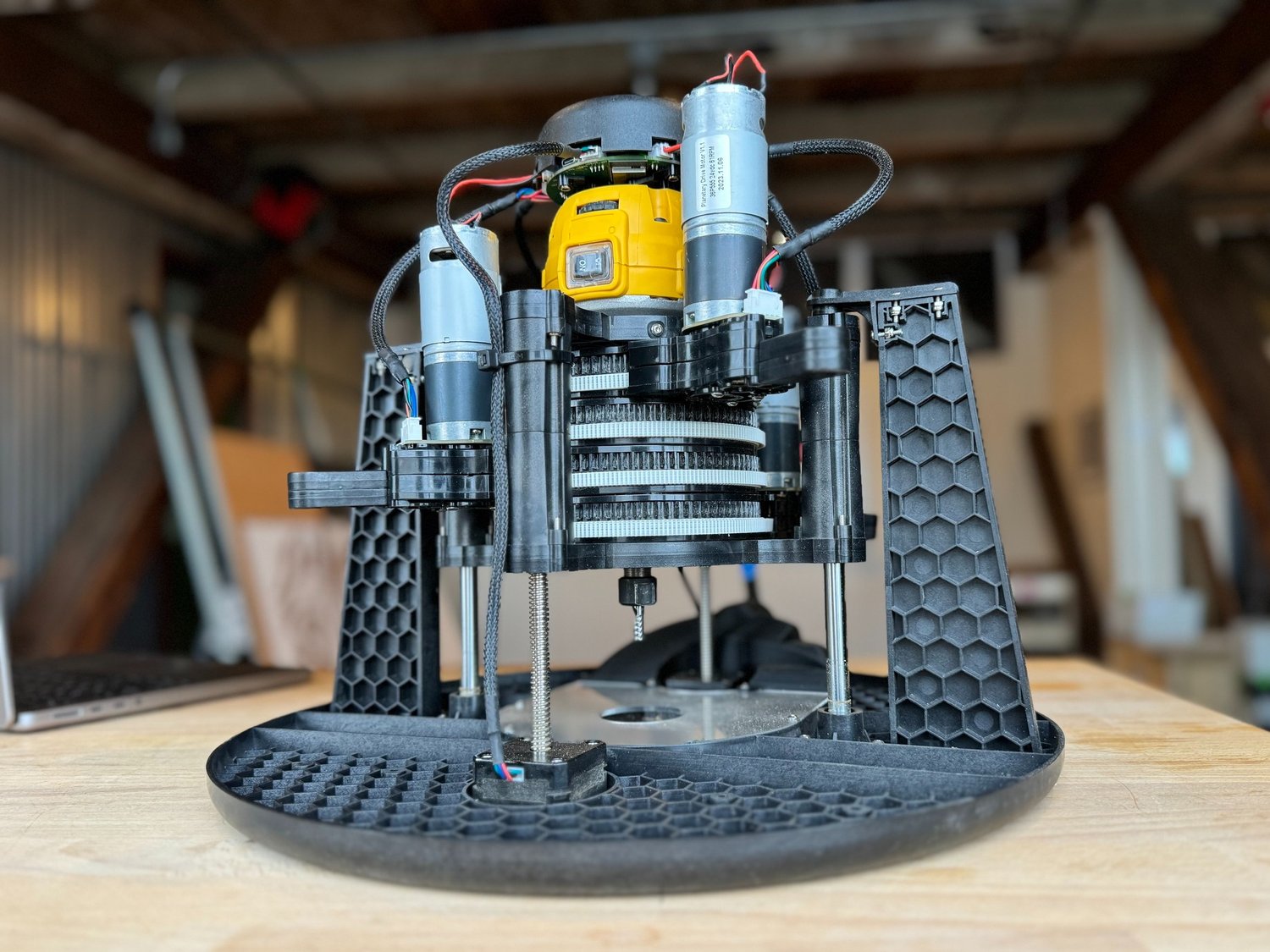
Maslow 4 CNC Guide: Full-Sheet Routing from a Wall-Mounted Machine for $500
Maslow is a machine for shops that don't have floor space. It hangs from the ceiling corners of a vertical frame, suspending a router in front of a 4×8 sheet of plywood. The footprint is the depth of a cabinet door. The work envelope is the same as a 4×8 router table, but it mounts to your wall and
Table of Contents
- The Fundamental Design: Hanging Tool, Vertical Work
- Original Maslow vs. Maslow 4: The Critical Difference
- Accuracy in 2024
- Build & Frame
- Motor & Spindle Reality
- Controller & Firmware
- What You Can Actually Cut
- Footprint vs. Capability: The Genius Part
- The Vertical Work Reality Check
- Upgrade Path & Expansion
- Community & Documentation
- When Maslow 4 Wins
- When Maslow 4 Loses
- Verdict
- Shop This Guide
- Related Articles
Maslow is a machine for shops that don't have floor space. It hangs from the ceiling corners of a vertical frame, suspending a router in front of a 4×8 sheet of plywood. The footprint is the depth of a cabinet door. The work envelope is the same as a 4×8 router table, but it mounts to your wall and costs under $600.
The original Maslow (bar linkage) had a reputation issue: accuracy degraded toward the corners due to gravity affecting the linkage geometry. The community redesigned it. Maslow 4 replaces the bar linkage with a belt/cable tension system that actively compensates for gravity effects. The result is genuinely capable for 2D work—cabinet parts, signs, panel routing, flat profiles. It's not 3D carving (the work is vertical, gravity doesn't cooperate), but it's honest, precise, and absurdly space-efficient.
The Fundamental Design: Hanging Tool, Vertical Work
Unlike every other CNC on this site, Maslow doesn't have a horizontal table. The work surface is vertical. The tool hangs from cables anchored to the top corners of the frame. As the tool moves, cable tensions adjust to keep it stable against the work.
This is either genius or weird depending on your space. Genius if your shop is a corner of your garage and you have wall space. Weird if you have a dedicated machine area and floor space to spare.
Original Maslow vs. Maslow 4: The Critical Difference
Original Maslow (bar linkage):
- Mechanical linkage created accuracy issues toward corners
- Gravity created sag and hysteresis
- Community complained about cutting quality
Maslow 4 (belt/cable tension):
- Active cable tension adjusts for gravity effects
- Significantly improved corner accuracy
- Firmware handles geometry compensation
- Actually production-capable for flat panel work
The community drove this redesign. Several independent developers (most notably looking at you, the Maslow forum) contributed redesigns. The current Maslow 4 is genuinely better. If you're considering this, Maslow 4 is the only sensible choice.
Accuracy in 2024
A properly tuned Maslow 4:
- Repeatability: ±2mm across a 4×8 sheet (reasonable for plywood work)
- Edge quality: clean, acceptable for furniture parts
- Corner accuracy: dramatically improved over original; flat along edges and corners
- Best accuracy: the center 3×6 area where mechanical advantage is highest
These numbers mean: it works for cabinet doors, shelving, signage, and flat profiles. It's not precision machinery, but it's genuinely useful. A sign shop could run one. Furniture makers use them seriously.
Build & Frame
The frame is 2×4 lumber—seriously. You assemble a simple rectangular frame that's 4 feet wide and 8+ feet tall (accounting for top brackets and cable anchors). The vertical plywood sheet mounts in front. The frame itself is the structure; it doesn't need to be fancy.
Some builders reinforce with diagonal bracing; some don't. The community has designs for everything from "bare minimum" to "seriously overbuilt." A basic frame takes ~20 hours to fabricate and costs under $100 in material.
Motor & Spindle Reality
Maslow 4 uses:
- Dual stepper motors (NEMA17) for X-Y movement via cable drive—each motor winds cable on a pulley
- Makita RT0701C trim router mounted on the moving carriage (this is the standard, proven choice)
- 12V PSU for steppers, ~5A typical
- Controller: custom firmware on ESP32 (community-driven, excellent)
Cost breakdown:
- Kit price (from Maslow community shop): ~$450–550 depending on what you source yourself
- DIY from scratch: $400–500
- Add frame materials: ~$100
Total: $500–650 all-in including frame.
Controller & Firmware
Maslow 4 runs custom firmware on an ESP32 board. The controller is open-source and actively maintained by the community. It handles:
- Cable geometry calculations (this is the magic—continuous compensation for gravity)
- Motor speed synchronization (critical; any sync error causes skew)
- Limit switches and homing
- Serial/USB communication with CAM software
The firmware "just works" if you flash it correctly. There's a learning curve the first time; after that, it's transparent.
What You Can Actually Cut
Good use cases:
- Cabinet doors and sides
- Plywood shelving and brackets
- Wooden signs and panels
- Acrylic sheet work (thin acrylic up to 3mm)
- MDF work
- Panel patterns for larger projects
Bad use cases:
- Anything requiring 3D carving (vertical work + gravity = no dice)
- Anything smaller than ~100×100mm (tool reaches are awkward)
- Metal (no matter what router speed)
- Cutting forces don't apply vertically—gravity actually helps with chips falling away
The honest truth: if your work is flat 2D profiles in sheet material, Maslow 4 is competent and space-efficient. If you need anything else, pick a different machine.
Footprint vs. Capability: The Genius Part
| Machine | Floor Footprint | Work Area | Best For |
|---|---|---|---|
| Maslow 4 | ~12×24" (frame depth) | 48×96" | Flat panels, signs, cabinet parts |
| LowRider CNC | Frame sits on work | 48×96" | Same, but floor-sitting |
| MPCNC Primo | 36×36" table footprint | 24×24" work | Smaller precision work |
| PrintNC | 48×48"+ (build-dependent) | 24–48" | Aluminum, mixed materials |
Maslow's killer feature: you can store the frame in a corner or lean it against a wall when not in use. A LowRider sits on the floor always. An MPCNC needs a dedicated table. PrintNC is substantial. Maslow folds into negative space.
The Vertical Work Reality Check
Mounting work to a vertical surface requires:
- Hold-downs: you can't rely on gravity; clamps are essential
- Dust management: chips fall straight down (good) or get pressed into work (bad, depending on tool height)
- Bit contact: the tool pushes work away; you need mechanical support
This is solvable—the community has excellent hold-down designs—but it's different from a horizontal table. Budget 15–30 minutes per work piece for clamping setup.
Upgrade Path & Expansion
Maslow 4 is relatively static. You upgrade by:
- Spindle swap: moving to a more powerful router (makita is maximal for plywood; anything heavier needs custom brackets)
- Cable tuning: tightening geometry over time
- Firmware updates: the community pushes improvements regularly
You don't "upgrade into" a larger machine; you upgrade within Maslow 4. It's a point solution, not a stepping stone.
Community & Documentation
- Maslow.community: official site, forums, documentation
- GitHub: firmware and hardware files
- Discord: community support is active and responsive
- YouTube: build videos exist but less comprehensive than PrintNC or MPCNC
The community is smaller than MPCNC or PrintNC but passionate. People using Maslow for sign work or furniture are vocal and helpful.
When Maslow 4 Wins
- You have wall space but no floor space: this is the machine
- You want a 4×8 capability for under $600: nothing else comes close
- Flat panel work is 80% of your cutting: optimized for this
- You like the idea of space-efficient machines: wall-mounted is genuinely clever
- Maker spaces & community shops: excellent for shared spaces where floor footprint is precious
When Maslow 4 Loses
- You need 3D carving or relief: gravity + vertical work don't cooperate
- Precision under 2mm matters: it's not that accurate
- You cut metal regularly: router speed + vertical geometry = not ideal
- You need rigid support for heavy cutting passes: cables flex slightly under load
Verdict
Maslow 4 is the best space-efficient sheet-routing machine on the market. It's not as rigid as PrintNC or MPCNC, but it's genuinely capable for flat panel work. The community redesign (moving to belt/cable tension) was a real improvement. At $500–650 all-in, it's one of the cheapest full-sheet systems available.
Build this if you're in a maker space with limited floor room, cutting lots of cabinet parts, or want to prove the concept works before investing in a LowRider. Skip it if you need precision under 1mm, 3D work, or metal cutting.
Shop This Guide
| Component | Source | Notes |
|---|---|---|
| Maslow 4 Kit | Maslow.community shop → | Official kit, includes motors, electronics, cables; frame DIY |
| Makita RT0701C Router | Amazon → | THE standard for Maslow; proven, reliable, good trim router |
| Lumber for Frame | Local hardware store | 2×4, approximately 80–100 board feet depending on design |
| Plywood Work Surface | Local home center | Standard 3/4" plywood, one 4×8 sheet recommended |
| Hold-Down Clamps | Amazon: C-clamps assortment → | 8–12 clamps typical, various sizes |
| Cable & Pulleys | Maslow kit includes | If sourcing separately: guitar cable + small pulleys |