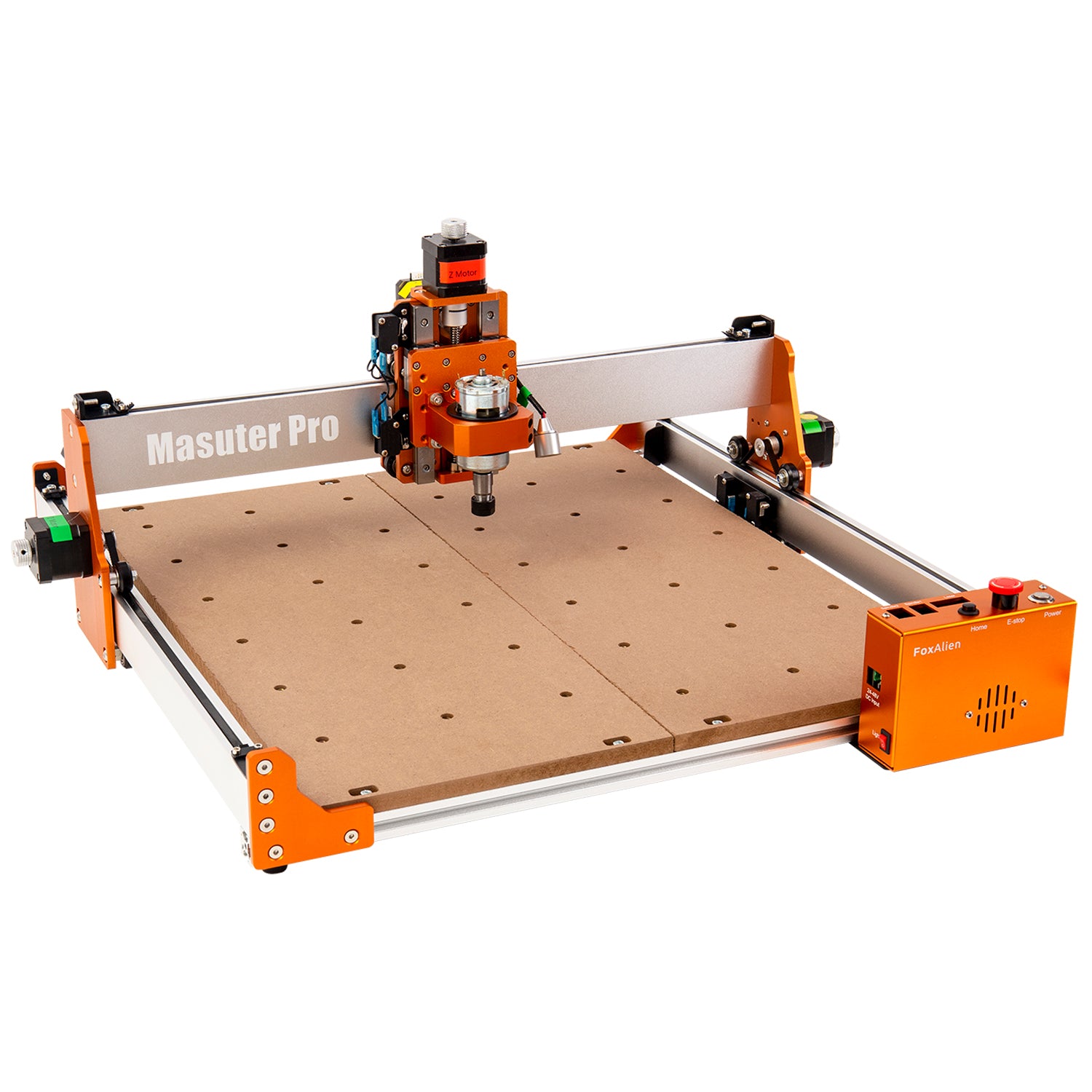
Cutting Hardwood on a Hobby CNC: Oak, Maple, and When Your Machine Isn't Ready
Keywords: cutting hardwood hobby CNC, CNC router hardwood feeds speeds, oak maple CNC router settings
Table of Contents
- Hardwood Reality Check
- What You Actually Need
- Chip Load: The Number That Ties Everything Together
- Recommended Settings by Species
- Grain Direction Matters: With vs Against
- Bit Selection for Hardwood
- The Heat and Burning Problem
- Workholding: Forces Are Real
- Climb Milling for Finish Passes
- Species-Specific Notes
- What We'd Buy
- Shop This Guide
- Related Articles
Slug: /guides/cutting-hardwood-hobby-cnc/
Read time: 8 min
Keywords: cutting hardwood hobby CNC, CNC router hardwood feeds speeds, oak maple CNC router settings
Hardwood Reality Check
Your budget CNC can cut oak and maple. It can. But not the way you expect—not deep, not fast, not without careful setup.
Hardwood is 2–3× denser than softwood. Cutting forces scale with density. A spindle rated for MDF and plywood starts struggling the moment you try to mill hardwood at serious depth. NEMA23 motors that push a Shapeoko 5 through MDF fine will stall in oak.
This isn't a dig at hobby machines. It's reality: hardwood requires more rigidity, more spindle power, and more respect for speeds and feeds than softer materials. Get it wrong and you're breaking bits, stalling the spindle, or marring the finish.
Get it right and the detail is worth it.
What You Actually Need
Absolute minimum:
- NEMA23 stepper motors (not NEMA17)
- 1.5kW spindle minimum (preferably water-cooled VFD)
- Rigid spindle mount (not a trim router with runout)
- Proper workholding (clamps + tape; tape alone will slip)
Reality check: A 500W trim router on a V-wheel machine won't reliably cut hardwood. Those machines excel at MDF and plywood. Hardwood requires a step up.
The best hobby CNC for hardwood is something like:
- PrintNC: Full rigidity, excellent spindle mounting, widely available hardwood success stories
- Onefinity Woodworker: Industrial spindle mount, VFD-ready, proven with hardwood
- Heavily modified Shapeoko 5 Pro: Possible with ballscrew upgrade + better spindle mount
- IndyMill: Purpose-built for this, costs but delivers
Chip Load: The Number That Ties Everything Together
Chip load = feed rate / (RPM × number of flutes)
For hardwood, target chip loads are 0.025–0.05mm per tooth.
Example: Oak, 18,000 RPM, 2-flute bit, aiming for 0.035mm chip load:
Feed rate = 0.035 × 18,000 × 2 = 1,260 mm/min
That's your starting point. Not fast, not slow—precise.
Too slow (below 0.015mm): Rubbing, burning, bit dulls fast, heat buildup
Too fast (above 0.08mm): Tool deflection, chatter, potential breakage
Most hardwood failures trace back to chip load being wrong, not the machine being inadequate.
Recommended Settings by Species
| Wood Species | RPM | Feed (mm/min) | DOC (mm) | Notes |
|---|---|---|---|---|
| Oak | 18,000 | 1,000–1,800 | 2–4 | Coarse grain, variable hardness |
| Maple | 18,000 | 1,200–1,800 | 2–4 | Very hard, dulls bits faster |
| Walnut | 18,000 | 1,500–2,200 | 3–5 | Forgiving, cuts cleanly, machines beautifully |
| Cherry | 18,000 | 1,500–2,200 | 3–5 | Similar to walnut, slightly easier |
| Ash | 18,000 | 1,200–1,800 | 2–4 | Hard but clean, good surface finish |
Start at the conservative end. Increase 10–15% if you see clean chips and no chatter.
Grain Direction Matters: With vs Against
Wood has grain direction. Cutting "with the grain" is easier; cutting "against the grain" causes tearout.
Strategy:
- Rough pass: any direction is fine if DOC is conservative
- Final pass: climb mill (cut against the grain direction) with shallow DOC (0.3–0.5mm)
A single 0.3mm climb pass can eliminate 90% of tearout on hardwood. It's worth the extra time.
Climb milling caveat: It requires very tight backlash control. If your machine has loose ballscrews or worn nuts, climb milling can cause the bit to dig in. Test on scrap first.
Bit Selection for Hardwood
Upcut spiral, solid carbide, sharp edges is the standard.
Number of flutes:
- 1-flute: Best for plastics, not ideal for hardwood
- 2-flute: Workhorse for wood, balance of speed and surface finish
- 3-flute: Excellent for hardwood finish passes, smoother cut, slower feed rates
Edge sharpness matters more in hardwood than in soft materials. A dull bit causes burning and excessive heat. Replace bits more frequently than you'd think.
The Heat and Burning Problem
Smoke = bad. Black discoloration = bad. These mean:
- Feed rate is too slow (rubbing instead of cutting)
- Bit is dull
- Spindle speed is too slow for the material
- DOC is too shallow (see problem 1)
If you see smoke, stop immediately. Burning wood produces acrid fumes and ruins the cut. Back off the feed rate, check bit sharpness, and try again.
Clean hardwood cuts should smell like fresh-cut wood, not burnt.
Workholding: Forces Are Real
Hardwood generates significant cutting forces. Tape alone often isn't enough. Use:
- Clamps at strategic points (near areas being cut)
- Double-sided tape (provides some holding power, not the only method)
- Cauls (sacrificial wood pieces under clamps to distribute pressure)
Test workholding on scrap. If the piece shifts during a cut, everything goes wrong.
Climb Milling for Finish Passes
After roughing with conventional milling, a single light climb pass can transform surface quality:
- Rough pass: conventional (feed into the tool), DOC 3–4mm, feed 1,200 mm/min
- Finish pass: climb (tool pushes into the feed direction), DOC 0.3mm, feed 1,500 mm/min
This works because the climb pass is so shallow that the tool isn't fighting much resistance, but it's cutting cleanly against the grain.
Requirement: Tight backlash control and proven machine rigidity. Test on scrap first.
Species-Specific Notes
Oak: Coarse grain, variable hardness within the same board. Grain direction is very visible. Sand and finish carefully—raised grain is annoying. Good learning material because it's forgiving on cuts.
Maple: Hard, dense, dulls bits faster than oak. Grain is tighter and often more uniform. Beautiful finish possible with sharp bits and correct speeds. Not forgiving of slow feeds (burns easily).
Walnut: The hobbyist's favorite. Machines beautifully, cuts cleanly, finishes dark and rich. Surprisingly forgiving on speeds/feeds. If you're going to try hardwood, start here.
Cherry: Similar to walnut but slightly easier. Beautiful deep red finish. Worth the effort.
What We'd Buy
For hardwood CNC work:
- Solid carbide 1/4" upcut spiral ($20–30): Get at least two
- 1/8" carbide upcut ($18–25): For detail and finer pockets
- 2-flute finishing bits ($20–30): For final passes
- Premium hardwood for first attempts ($40–60): Start with walnut, not oak; the success rate is higher
- Sharp bit depth gauge ($15–20): For consistent DOC on multi-pass cuts